
You sat through two demos this week. The Aesthetic Record rep showed a clean chart, patient photos, and a payments screen, then said the price depends on your setup and promised a quote by email. The PatientNow rep showed marketing tools and patient financing, then steered you toward “let’s build a package for your practice.” Two hours gone, and you still cannot answer the one question your medical director asked in the hallway: what does this actually cost us per month, all in?
Here is the honest answer up front: neither company publishes a real price, and that is the whole game. Aesthetic Record is reported at roughly $15 to $19 per user per month plus a one-time setup fee around $399, with marketing, texting, and payments stacked on top as you grow (SoftwareAdvice; Pabau). PatientNow discloses no number at all, is estimated at roughly $400 per month for one user up to around $2,000 for ten, and locks you into a 12-month contract reviewers say is hard to escape (Pabau; Capterra). So Aesthetic Record is cheaper to start and priced per seat; PatientNow is pricier, bundled, and contract-locked. Below, we break both down across the eight things that decide your bill and run the math for three clinic shapes.
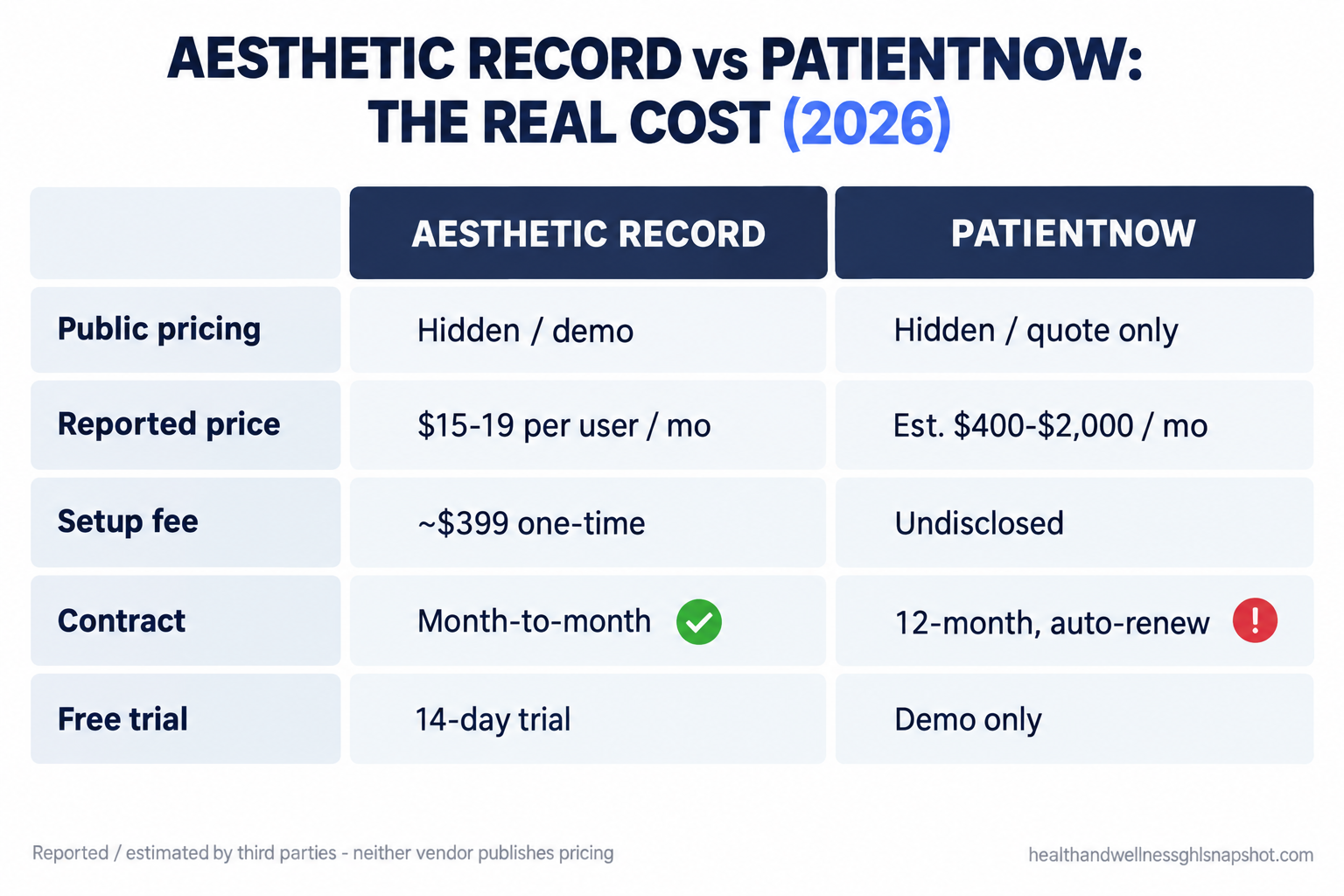
Table of contents
- Why both demos end with you still not knowing the price
- What one-and-done clients cost you while you shop
- The eight things that decide your bill
- Aesthetic Record: what it actually costs
- PatientNow: what it actually costs
- Ratings and what reviewers actually complain about
- What a solo IV bar, a two-location spa, and a four-location group each pay
- Where each platform quietly breaks
- Compliance corner: contracts, HIPAA, and health claims
- Common objections, answered honestly
- Frequently asked questions
Why both demos end with you still not knowing the price
When a vendor makes you book a call to learn the price, the price is a negotiation, not a number. Aesthetic Record and PatientNow are the two platforms in this category that publish no clear pricing table (Capterra), which tilts the deal toward the rep, who knows your budget before you know their floor. The fix is to force the full, all-in monthly number out of each rep in writing, including every add-on you will actually turn on, and this guide gives you the figures to pressure-test their quotes against.
If you prescribe GLP-1 or hormones and need a prescriber-grade clinical record, that is a different shelf of software, and we drew that line in our Cerbo vs Healthie comparison. This piece is for the aesthetics and IV owner, often a non-clinical owner working with a contracted medical director, choosing a platform to run scheduling, charting, memberships, payments, and marketing in one place.
What one-and-done clients cost you while you shop
The software is a cost; the leaking revenue it is supposed to fix is usually bigger.
Per the American Med Spa Association’s 2024 report, the average single med-spa location earns about $1,398,833 a year, up from $1,307,587 (AmSpa), while Grand View Research puts the IV hydration market at about $3.0 billion in 2026, growing 9.2% a year (Grand View Research). Against that, Zenoti’s industry data puts the average med-spa no-show rate near 5% and the average ticket around $454, so one no-show a week quietly costs a clinic near $22,000 a year (Zenoti). That is vendor-sourced and directional, but a handful of no-shows and one-and-done clients a week is a bigger hole than the price gap between any two tools. So the question is never “which is cheaper,” it is “which plugs the leaks, at a cost I can see before I sign.” Our post on why IV therapy clients only come once walks that repeat-visit sequence.
The eight things that decide your bill
The monthly sticker is one line of the invoice. These eight items are where the real money, and the real lock-in, hide. The contract row is the clearest difference between the two.
| What you are comparing | Aesthetic Record | PatientNow |
|---|---|---|
| Public pricing | No table; demo-gated | None; “contact us” only |
| Reported base price | ~$15–$19 per user/mo | Est. ~$400–$2,000/mo by users |
| Setup / onboarding fee | ~$399 one-time (reported) | Reported substantial, undisclosed |
| Free trial / free tier | 14-day trial, no free tier | Demo only |
| Contract | Month-to-month or annual | 12-month, auto-renew (per reviewers) |
| What’s bundled | EMR, scheduling, memberships, e-commerce | EMR, marketing, photos, financing |
| Main add-ons | Marketing, texting, payment processing | Fewer add-ons; more in the bundle |
| Best fit | Med spa / IV, cost-conscious, per seat | Larger / plastic-surgery, marketing-heavy |
Sources: SoftwareAdvice, Pabau (Aesthetic Record, reported); Pabau, Capterra (PatientNow, estimated). Neither vendor publishes a price; confirm in writing with each rep.
Aesthetic Record: what it actually costs
Aesthetic Record is the per-seat option: a low headline, a real trial, and cost creep that lives in the add-ons and processing fees, not the base plan.
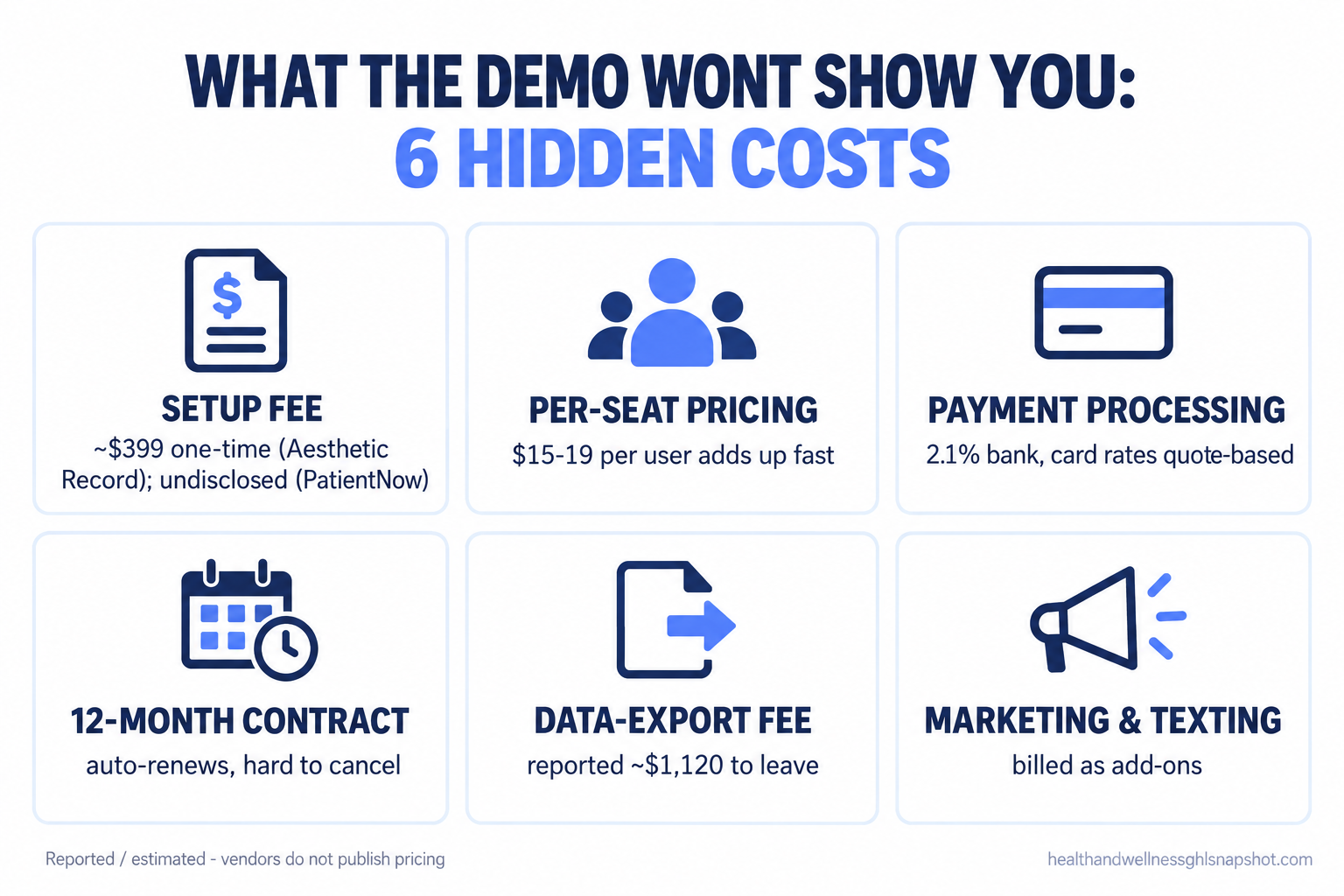
Aesthetic Record publishes no pricing, but listing sites and a recent teardown consistently report two tiers: Essentials at about $15 per user per month and Accelerator at about $19, with a one-time setup fee around $399 and a 14-day trial (SoftwareAdvice; Pabau). Older listings showed rates near $12 to $16. There is no free forever plan; Enterprise is custom.
That low per-seat number is why it looks cheap, and why the real cost is easy to underestimate. Marketing, extra texting, and payment processing are where the bill grows. Aesthetic Record runs payments through AR Pay, with Text2Pay links and patient financing through Cherry, Affirm, and others (Aesthetic Record); bank payments are reported at a 2.1% rate, while card rates are quote-based, so pin those down. Memberships and e-commerce are strong, which matters as the industry shifts toward recurring revenue.
One more line to verify: a competitor teardown cites user reports of a charge near $1,120 to export your patient data if you leave (Pabau). I could not confirm that on a primary source, so treat it as unverified, but get your export terms in writing.
Illustrative first-year monthly cost. Aesthetic Record uses the reported $15/user rate with the $399 setup amortized over 12 months; PatientNow figures are third-party estimates. Sources: SoftwareAdvice, Pabau.
PatientNow: what it actually costs
PatientNow is the bundled, marketing-heavy option that locks you in: a higher, less visible number attached to a 12-month commitment.
PatientNow is the merged product of PatientNow, Crystal Clear Digital Marketing, and RxPhoto, with TouchMD in the family (RxPhoto). It bundles EMR and practice management with lead-generation marketing, before-and-after photo tools, and patient financing. That is its real pitch: fewer subscriptions, one bill. It leans toward plastic surgery and larger practices more than the solo IV bar.
The pricing is the hard part, because there is none to see. PatientNow lists its model as “contact us,” so every number in circulation is a third-party estimate. The most-cited range puts it at roughly $400 per month for a single user, scaling toward $2,000 around ten users, with a lighter “Essentials” tier added in late 2025 (Pabau). Setup is widely described as substantial, but no primary dollar figure exists, so do not accept a setup number until it is on your quote.
Then the part the demo will not dwell on. Reviewers repeatedly flag a 12-month auto-renewing contract. One Capterra reviewer reports being charged for the full 12 months after two and a half days of use; another was told to pay for the remaining eleven to cancel (Capterra). Ask directly about term length, auto-renewal, notice window, and what happens to your data and bill if you leave early.
Ratings and what reviewers actually complain about
On paper PatientNow rates higher, but the two fail in opposite directions: one on cost creep, the other on contracts and post-sale support.
On Capterra, Aesthetic Record carries about 3.5 out of 5 from roughly 75 reviews (around 53% positive) (Capterra). PatientNow carries about 3.9 out of 5 from nearly 300 reviews, with subscores of Ease of Use 3.8, Support 4.0, Value 3.7, Features 3.8, and 70% likelihood-to-recommend (Capterra). More reviews and a higher average give PatientNow the nominal edge.
Overall Capterra ratings out of 5, at time of writing. Sources: Capterra (Aesthetic Record), Capterra (PatientNow).
The complaints matter more than the averages. Aesthetic Record reviewers cite too many steps in navigation and the add-on structure that grows the bill; PatientNow reviewers cite the 12-month contract and onboarding contacts who go quiet after the deal closes while billing continues (Capterra).
What a solo IV bar, a two-location spa, and a four-location group each pay
One comparison, three real shapes, and the right answer changes with each.
Scenario 1: solo cash-pay IV bar, one or two providers
You run drips and injectables and want one place to book, chart a consent, and take payment. Aesthetic Record is the natural fit: one or two seats at about $15 each plus the setup puts you under roughly $50 a month in year one, with AR Pay and memberships built in. PatientNow’s estimated $400-plus floor and 12-month contract are hard to justify for a one-chair bar that does not need heavy marketing software, so unless you want its lead-gen and photo tools specifically, Aesthetic Record wins.
Scenario 2: two-location med spa with a contracted medical director
Now it gets closer. Aesthetic Record stays cheaper on the base subscription, maybe $150 to $300 a month across both sites, but you will bolt on marketing and texting and carry the processing rate on higher volume. PatientNow’s bundle is more defensible here, since the marketing, photos, and financing you would otherwise buy separately are inside it, but you accept the 12-month lock-in to get it.
Scenario 3: four-location aesthetics group, injectables plus memberships
At this size it is less about the monthly rate and more about consistency, reporting, and switching cost. PatientNow’s all-in-one bundle can cut the number of vendors you manage across four sites. Aesthetic Record can still be cheaper per seat, but the add-ons and processing fees add up, so nail down multi-location reporting and data-export terms in the contract. Our med-spa software cost teardown lays every vendor side by side.
Where each platform quietly breaks
Every tool has a failure mode the demo will not show you. Here are the ones that cost clinics money.
Aesthetic Record breaks on cost creep and the exit. The low per-seat headline is only the base. Turn on marketing, texting, and payment processing and the real monthly number climbs well past the sticker, and the reported data-export charge means leaving is not free either (Pabau). The fix: price the full stack you will use on day one, not the Essentials line, and get the export terms in writing first.
PatientNow breaks on the contract and the handoff. The bundle is convenient, and the 12-month auto-renewing commitment is hard to unwind if the product does not fit. Pair that with the recurring complaint that onboarding contacts go quiet after the sale, and you can be locked into a year of a tool that was oversold (Capterra). The fix: treat the contract as a negotiation point, and insist on a written onboarding plan with named owners and dates.
Both break at the marketing and retention edge. Neither reliably chases a no-show back onto the calendar, asks for a Google review when a client is happiest, or re-warms the client who came once and vanished, which is the quiet reason so many clinics carry a third subscription. Our guide to reducing no-shows at a wellness practice walks that recovery sequence in order.
Compliance corner: contracts, HIPAA, and health claims
Three things here cost owners more than a subscription ever will: a contract you did not read, a HIPAA gap you assumed away, and a marketing claim you cannot back up.
On contracts, read the term and cancellation clause before the demo charm wears off. A 12-month auto-renewing agreement is common here, and the expensive surprise is the renewal window, not the first signature. Ask in writing how and by when to cancel, and what it costs to leave.
On HIPAA, do not assume the exemption. If you bill insurance or share protected health information with a lab or referring physician, you are almost certainly a covered entity and need a signed Business Associate Agreement with any platform storing charts, photos, or texts (HHS). A cash-pay IV bar with no insurance billing may fall outside federal HIPAA but still owes state privacy duties. Either way, confirm the vendor signs a BAA at your tier. On marketing claims, the FTC issued Notices of Penalty Offenses to nearly 700 health-product marketers in 2023 (FTC) and has warned IV-therapy companies over immune and COVID claims (FTC), so keep “boosts immunity” and “melts fat” out of your automated copy unless you have the evidence. Our HIPAA-aware SMS guide covers the consent rules.
Common objections, answered honestly
“They both hid the price. Isn’t any number you quoted basically a guess?” The per-user band for Aesthetic Record and the ratings are reported consistently across software-listing sites, so they are solid directional figures. The PatientNow numbers are genuinely third-party estimates, which is why we label them so. The point is to arm you so you can pressure-test each rep’s quote and spot when a number is out of line.
“PatientNow rates higher on Capterra. Doesn’t that settle it?” A higher average across more reviews is a real signal, but not the whole story. Read the one-star and three-star reviews, because that is where the contract and post-sale support complaints live. A tool can rate well and still be the wrong fit for a two-chair IV bar that cannot absorb a 12-month lock-in, and neither runs the retention sequence our CRM and workflow automations handle.
The bottom line
Back to that hallway question. You could not answer it because neither company wanted you to leave with a number. So decide on what you can pin down. Aesthetic Record is the lower-cost, per-seat, month-to-month option for a cost-conscious med spa or IV bar, as long as you price the add-ons and get the data-export terms in writing. PatientNow is the pricier, bundled option that can suit a larger or plastic-surgery practice, as long as you go in clear-eyed about the 12-month contract. Whichever you pick, the retention layer that drives repeat revenue is the one piece neither does well. To see how much of that can run on a system you buy once instead of rent, book a quick demo and compare it against the tools you are weighing now.
Frequently asked questions
How much does Aesthetic Record cost per month in 2026?
It does not publish pricing, but listing sites report two tiers: about $15 per user per month for Essentials and about $19 for Accelerator, plus a one-time setup fee around $399, with a 14-day trial and no free plan. Marketing, extra texting, and payment processing are add-ons on top.
How much does PatientNow cost, and is there a setup fee?
PatientNow is quote-only. Third parties estimate roughly $400 per month for one user, scaling toward $2,000 around ten users, with a lighter Essentials tier added in late 2025. Setup is described as substantial, but no reliable public figure exists, so insist on the exact setup fee in writing before you sign.
Does PatientNow lock you into a 12-month contract?
Multiple Capterra reviewers describe a 12-month contract with automatic annual renewal that is hard to cancel, including reports of being charged for the full term after a few days of use. Confirm the term, auto-renewal, notice window, and any early-exit cost in writing before committing.
Which is better for a med spa, Aesthetic Record or PatientNow?
For a cost-conscious med spa or IV bar wanting a per-seat, month-to-month tool with memberships and built-in payments, Aesthetic Record usually fits better. For a larger or plastic-surgery practice that wants marketing, photos, and financing bundled and can accept a 12-month contract, PatientNow can make sense.
Are Aesthetic Record and PatientNow HIPAA compliant, and do they chase no-shows?
Both support HIPAA-aligned workflows, but confirm a signed Business Associate Agreement at your tier before protected health information flows through either. Neither reliably runs a full no-show recovery and re-warm sequence, so most clinics add a separate automation layer for that retention work.
This article is for general informational purposes and is not legal, medical, or compliance advice. Aesthetic Record and PatientNow do not publish public pricing; every price here is reported or estimated by third parties as noted and changes frequently, so confirm the current figure and all contract terms in writing with each vendor before purchasing. Each practice is responsible for its own HIPAA, TCPA, FTC, and state-licensing obligations.