
It is a Monday morning and you are between injections when a text comes in from a client three months into her weight-loss program. “Hey, I think I’m going to pause for a bit.” She has lost 18 pounds. She feels good. And that is exactly the problem: she feels good enough to stop, nobody has shown her what month four looks like, and a telehealth ad just offered her the same shot for less. You write back something warm, she says thanks, and you never see her again.
She did not quit because your care was bad. She quit because buying a monthly injection is a transaction, and transactions end the moment the buyer feels done or finds a cheaper one. This post is how you stop that. It is the full system for turning a one-time or month-to-month GLP-1 client into a committed member who stays through the plateau, through the maintenance phase, and through the price-shopping, with the real text copy you can lift, the timing that works, and the way each stage breaks so you can avoid it.
Table of contents
- What a quitting client actually costs you
- The six-stage retention system
- Stage 1: Decide the offer before you send one text
- Stage 2: Frame the first visit as a program, not a shot
- Stage 3: The weekly accountability check-in
- Stage 4: The 30-day milestone and the membership ask
- Stage 5: The plateau and the maintenance switch
- Stage 6: The pause-and-win-back save
- Run it for your size: solo, three-location, med-spa
- The compliance lines to respect in 2026
- Objections owners raise
- Frequently asked questions
What a quitting client actually costs you
A client who quits at month three is not one lost sale, she is every month she would have paid over the next year, plus the maintenance phase she never reached and the friends she never referred. The quitting is the expensive part, and it is happening at scale. In real-world data, more than half of adults who start a GLP-1 for weight loss have stopped within twelve months (via Medscape). A Cleveland Clinic analysis of people taking these drugs for weight loss put it at roughly 20% gone inside three months and about 52% gone by a year.
Cumulative share of weight-loss clients who have discontinued their GLP-1, by month (%). Source: Cleveland Clinic real-world analysis, via Medscape.
Run the math on your own clinic. Say a client pays $400 a month. Stay four months and drift, she is worth about $1,600. Stay a full year and roll into a lower-dose maintenance membership, she is worth $4,800 and climbing, at almost no new marketing cost. Same client, same first visit. The only difference is whether anything kept her through the moment she felt like stopping.
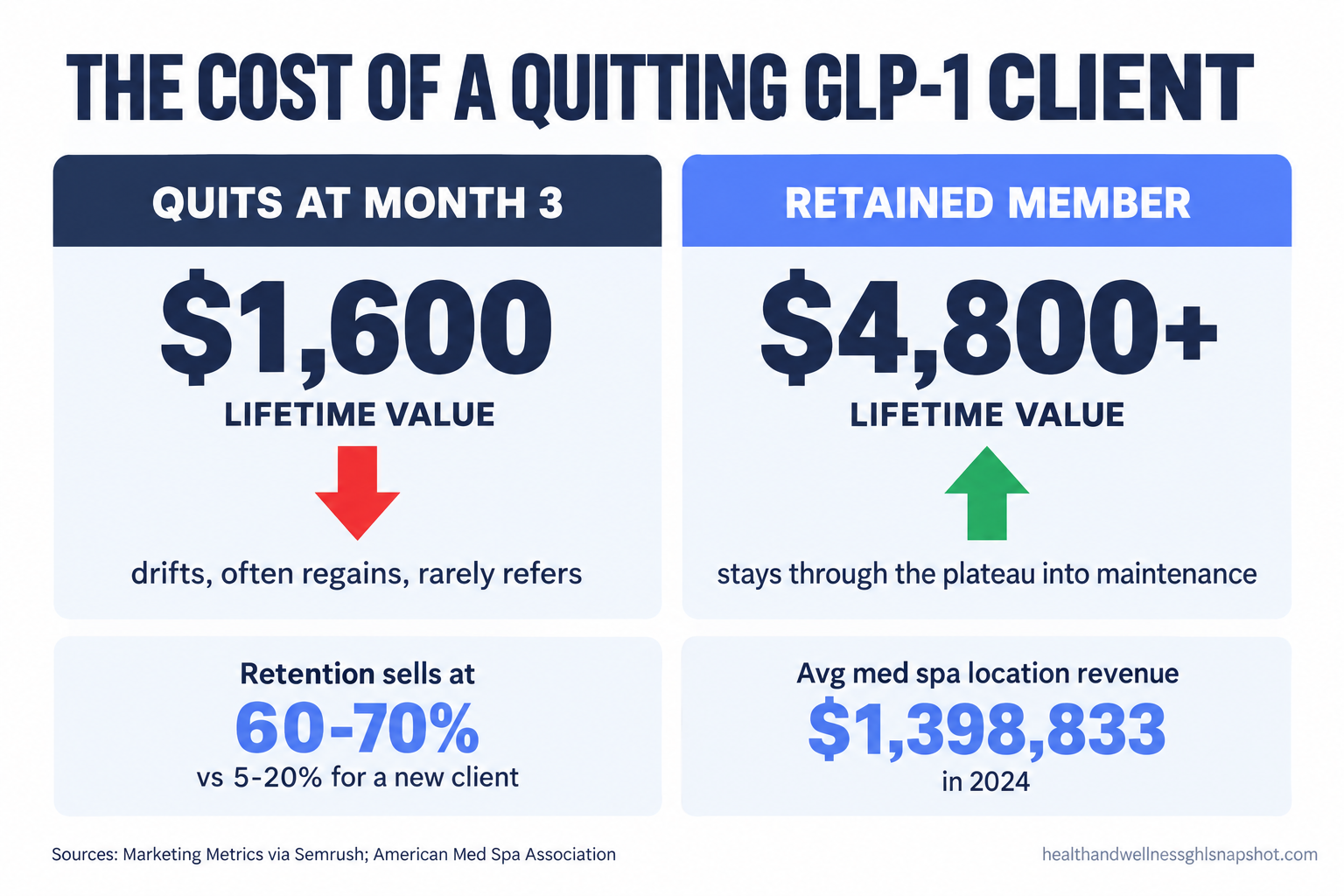
This is why keeping clients beats chasing new ones on pure math. The odds of selling again to someone you already have run 60–70%, against 5–20% for a brand-new prospect (Marketing Metrics, Farris et al., via Semrush), and raising retention by just 5% lifts profit 25% to 95% (Bain & Company via HBR). The money is also real: the average medical spa location did $1,398,833 in 2024, up from $1,307,587 in 2023 (American Med Spa Association), and return patients already make up about 70% of med spa visits (AmSpa). The demand is there. The leak is the gap between the shot and the follow-up.
The six-stage retention system
A retention system is a fixed sequence of touches that starts at the first visit and runs until the client is a committed member or has been politely let go. It is not a newsletter and not a loyalty punch card. It is a small set of well-timed messages, each with one job, that turn “I think I’ll pause” into “same time next month.” The six stages, in order:
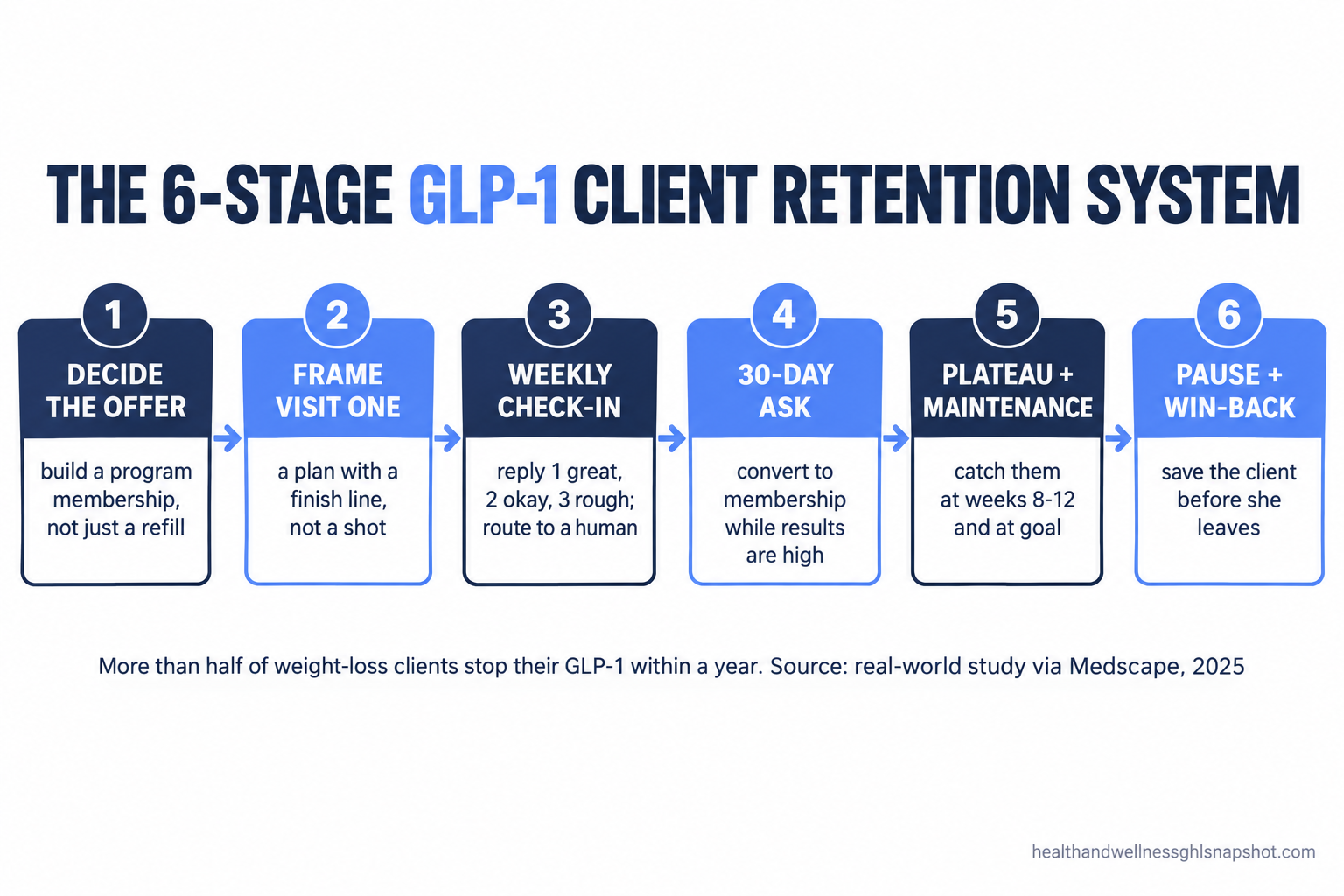
- Decide the offer so every message points at a membership, not a refill.
- Frame the first visit as a program the client is starting, not a shot she is buying.
- The weekly check-in, where accountability and trust get built.
- The 30-day membership ask, where the transaction becomes a commitment.
- The plateau and maintenance switch, where most clients quit if nobody catches them.
- The pause-and-win-back save, for the client who tries to leave anyway.
Every stage below has the same three parts: how to set it up, the copy to send, and the failure mode that quietly kills it. The failure modes matter most, because almost every clinic that says “we tried texting and it did not move the needle” tripped one of them.
Stage 1: Decide the offer before you send one text
No sequence works if the thing it is pointing at is wrong, so the first stage is a pricing decision, not a message. A client on a month-to-month injection is renting a result. A client on a program membership has bought into a plan with a finish line and a maintenance phase. Your copy, your check-ins, and your 30-day ask all aim at that membership, so it has to exist before you automate anything.
Build two things. First, a program membership: a 3 to 6 month commitment that bundles the injections, the check-ins, and a quarterly progress review into one monthly price. Second, a maintenance membership at a lower dose and lower price for the client who reaches her goal, because that is the client everyone loses. Here is the shape most weight-loss clinics land on:
Month-to-month vs a program membership
| Plan | Month-to-month injection | Program membership recommended |
|---|---|---|
| Price | ~$400/mo | ~$350/mo · 6-mo term |
| Feature 1 | Client pays per refill, cancels anytime | Injections + weekly check-ins + quarterly review |
| Feature 2 | No commitment, no finish line | A clear plan with a maintenance phase after |
| Feature 3 | Quits the moment she feels done or finds it cheaper | Priced below month-to-month for the committed client |
| Feature 4 | Average client lasts about 4 months | Built to carry the client past the plateau |
Setup: price the membership just below the monthly total a committed client would pay anyway, so it reads as the smart choice rather than an upsell. Decide the term, the maintenance tier, and what counts as “reaching goal” before you launch. The deeper pricing logic is the same one behind pricing wellness packages instead of selling a la carte.
Failure mode: having no membership to convert anyone into. If the only thing you sell is a monthly shot, every client is permanently one bad week away from canceling, because there is nothing to cancel out of and nothing to stay in for. Build the offer first. Everything downstream fails without it.
Stage 2: Frame the first visit as a program, not a shot
How you set up the first visit decides whether the client thinks she is starting a plan or buying a product, and that framing sticks for months. A client who leaves visit one believing “I am on a six-month program with a plateau phase and a maintenance phase” behaves completely differently from one who leaves thinking “I got my first shot.” Set the expectation out loud, in person, and then confirm it in writing that evening:
Hi [First name], it is [Provider] from [Clinic]. Great to meet you today and get you started. Quick reminder of the plan: we check in each week, your dose steps up over the first month, and most people hit their stride around weeks 6 to 8. I will be here the whole way. Reply here any time something comes up.
Notice the message sets a timeline and names the hard part before it happens, so when week six feels slow, it reads as “the plan” rather than “it stopped working.” It also does not promise a result or a number, which keeps you clear of FTC territory.
Setup: capture the mobile number with a clear, unbundled SMS opt-in at intake (more on that in the compliance section), tag the client as a weight-loss program start, and trigger this confirmation off the completed first visit. The whole first-visit experience is the same muscle as a strong client onboarding automation.
Failure mode: treating the first visit as a sale instead of a start. If nobody sets the timeline, the client invents her own, and her version ends the week the scale stalls. Say the plan out loud, then put it in writing so she can reread it when she wavers.
Stage 3: The weekly accountability check-in
The weekly check-in is where retention is actually earned, because it turns an injection into a relationship and a relationship is far harder to cancel than a refill. Once a week, a short automated text goes out that asks one simple question and invites a reply. It is not clinical advice and not a sales pitch. It is a human touch that keeps the client feeling seen between visits:
Hi [First name], [Provider] here checking in. How has this week felt, energy, appetite, any side effects worth flagging? Reply 1 for great, 2 for okay, 3 for rough and I will follow up. You are [X] weeks in and doing the work.
The reply does the routing. A “3” pings a real person to call before a rough week becomes a quit. A “1” gets a quick celebration. Either way the client learns that someone is paying attention, which is the single biggest reason people stay. This is the same weekly rhythm that works for daily and weekly check-ins without burning out the owner.
Failure mode: making it a one-way broadcast, or asking a question and then ghosting the reply. A check-in that never gets answered by a human is worse than no check-in, because it teaches the client that the “how are you doing” was fake. Keep clinical detail out of the text, route every “rough” reply to a person, and keep the tone a caring provider, not a billing system. Sending it in the wrong time zone, so your 9am note lands at 6am, reads as careless and is a common multi-location slip.
Stage 4: The 30-day milestone and the membership ask
The end of the first month is the one moment the client has proof it is working and has not yet hit the plateau, which makes it the right time, and the only easy time, to ask for the commitment. She has felt the early change, she trusts the weekly texts, and she has not yet had the “maybe I’m done” thought. Reach out at the 30-day mark, lead with her progress, then make the membership the natural next step:
[First name], you just finished month one, nicely done. Most people are finding their rhythm right about now. Our 6-month program keeps your injections, your weekly check-ins, and a progress review together for $[X]/month, which comes out lower than paying month to month. It is built to carry you through the middle stretch, which is where most people stall without support. Want me to send the details? Reply YES.
Price it below the month-to-month total, frame it as “built to carry you through the stall,” and make saying yes a single word. When she replies, your system sends the enrollment link so she signs up in two taps instead of waiting for a call.
Failure mode: asking too early or too late, or letting the enrollment stall on a phone call. Pitch the membership on day one and it feels like a timeshare. Wait until month three and she is already halfway out the door. And an ask that ends with “call us to sign up” loses the people who said yes but never found the time. Fire it at 30 days and make enrollment self-serve.
Stage 5: The plateau and the maintenance switch
This is the stage that decides your retention, because the plateau and the “I reached my goal” moment are exactly where that 52% walks out, and both are predictable enough to automate a save. Weight loss on a GLP-1 slows and stalls, that is normal, but to a client who was not warned it feels like failure or a reason to quit. And the client who hits her goal thinks the program is over, when really that is when a lower-dose maintenance membership should begin. Catch both with timed, honest messages.
For the plateau, around weeks 8 to 12:
Hi [First name], heads up: a lot of people see the scale slow down right around now. That is expected and it does not mean it stopped working, it means your body is adjusting. This is the stretch where staying consistent matters most. How are you feeling about it? Let’s talk at your next check-in.
For the client reaching her goal:
[First name], look how far you have come. A lot of people think this is the finish, but the research is clear that stopping often means the weight comes back, so the real win is maintenance. We have a lower-dose maintenance membership at $[X]/month to help you hold it. Want the details?
That maintenance pitch matters because when people stop these drugs, a large share of the lost weight tends to return, which is widely documented and is the honest reason to stay. The transition from active loss to maintenance is the same retention cliff we break down in why membership clients cancel after two months.
Failure mode: staying silent through the plateau and treating “goal reached” as a graduation. Silence at the stall is where clients quietly decide to quit, and congratulating someone out the door at goal is lost maintenance revenue and, often, a client who regains and blames you. Name the plateau before it arrives and offer maintenance before she thinks she is done.
Stage 6: The pause-and-win-back save
Some clients will say “I want to pause” no matter how good your system is, and this stage is the difference between losing them and keeping a good share for almost nothing. The 2026 version of this is specific: now that the shortages are over and cheap mass compounding has wound down, a client who sees a telehealth brand ad or a lower cash price will text you to pause. That is a retention moment, not a goodbye, if you answer it right. When someone asks to pause or cancel, respond fast, acknowledge the reason, and offer a bridge rather than a hard sell:
Hi [First name], totally understand, life and budgets are real. Before you pause, two options: we can step you down to our lower-cost maintenance membership so you do not lose your progress, or I can hold your spot for 30 days so your pricing does not reset. What works better for you?
For the client who already drifted away, a single win-back around 45 to 60 days lapsed recovers more than you would expect:
Hi [First name], we have missed you at [Clinic]. If you want to pick back up where you left off, I can get you restarted this month and skip the new-client intake. Here is my calendar: [link]. No pressure, just wanted you to know the door is open.
Setup: trigger the win-back off days-since-last-visit, route every pause request to a human within the hour, cap any discount, and send the win-back once (a second attempt a few weeks later is the most you should try). The full re-engagement timing lives in our client reactivation and win-back guide, and for the client whose card simply failed, a failed-payment recovery flow saves members you would otherwise lose silently.
Failure mode: answering a pause request a day later, or training clients to quit for a discount. Slow replies lose the client to the cheaper ad she was already looking at. And if every pause earns a price cut, your members learn to threaten to leave, so keep the bridge about value (maintenance, held pricing, skipped intake) rather than a reflex discount.
Run it for your size: solo, three-location, med-spa
The six stages are identical for every clinic, but who runs them and how they are staffed changes with your size and ownership model. The framework does not bend. The operations around it do.
The solo RN or NP clinic. You are the provider, the front desk, and the marketing department, so sending these messages by hand is the first thing that falls off on a busy day. Automation is the only way the system survives. Set all six stages to fire automatically and route only the human moments to your phone: the “3” check-ins, the pause requests, the membership yeses. Your job shrinks to the conversations that actually need you, which is also where a dedicated wellness virtual assistant earns its keep handling replies.
The three-location clinic. Now the risk is drift: one location runs warm, consistent follow-up and another forgets. Centralize the sequences so every location fires the identical flow, but stamp each client with her home location and time zone so the check-in names the right clinic at the right hour. One system, consistent voice, and no per-provider fee multiplying across seats, which is the same logic in running a clinic membership without a $300 add-on.
The med-spa with a contracted medical director. If you are a non-clinical owner working under an MD or DO medical director, the retention sequence is yours to run, but keep the clinical line clean: the automated texts handle logistics, accountability, and offers, while anything that touches dosing, side effects, or a medical decision routes to your clinical staff, not an auto-reply. The “reply 3 for rough” branch should ping a licensed person every time. That division keeps your marketing automation on the right side of scope-of-practice rules.
The compliance lines to respect in 2026
Automating client texts around a prescription weight-loss program means staying inside three lines: FTC health claims, HIPAA and privacy, and SMS carrier rules. The system above is built to clear all three, as long as you know where they are.
FTC health claims. The FTC sent penalty-offense notices to nearly 700 marketers in 2023, warning that unsupported product claims can draw civil penalties of up to $50,120 per violation (FTC), and it has specifically pressed weight-loss and IV-therapy marketing. So your texts and ads must not promise a pound count, call a drug a miracle, or imply your compounded product is identical to the brand. Every message above talks about the plan, how the week felt, and logistics, never a guaranteed outcome. Soften the claim or cut it.
The 2026 GLP-1 reality. The FDA declared the tirzepatide shortage resolved in late 2024 and semaglutide resolved on February 21, 2025, and the enforcement-discretion deadlines that let pharmacies mass-compound both drugs expired through the spring of 2025 (FDA actions via NCPA, and via Burr). “There is a shortage” is no longer a valid reason to compile at scale, so make sure your sourcing and your marketing both reflect the current rules. The retention upside is real too: as cheap compounded supply tightens, the clinic with an actual program and real support holds clients that a price-only seller cannot.
HIPAA and SMS rules. If you bill insurance or share client data with a lab or referring physician, you are likely HIPAA-covered and need a signed Business Associate Agreement with any vendor touching that data. A pure cash-pay clinic may fall outside federal HIPAA but still owes state privacy and breach-notification duties, so never assume the exemption. Keep texts to first names and logistics, never doses or results. And because health messaging draws heavier carrier filtering, register for 10DLC, capture a clear unbundled opt-in, and honor STOP instantly. Our HIPAA-aware SMS guide goes deeper.
Objections owners raise
“Won’t the weekly texts annoy people?” Only if you send the wrong ones. There is a wide gap between a warm “how did this week feel” from your provider and a barrage of “book now” ads. The system above is deliberately light: one framing text at the start, one check-in a week that invites a reply, timed plateau and milestone messages, and a single win-back. That is not spam, it is the attentiveness clients wish more clinics had, and STOP is always one tap away.
“I already run everything through my EHR or booking software.” Your charting system charts and your booking system books, but neither reaches out to a wavering client on its own at week eight to save the plateau. Those tools wait for the client to come to them. The retention sequence goes to the client. It sits alongside your clinical stack and does the one job those tools were never built for, which is why many owners run it on GoHighLevel rather than paying per-provider fees to bolt marketing onto a clinical tool.
“My clients are on a prescription, isn’t retention really about the medication working?” The medication is doing its job for most people, which is exactly why this is a retention problem, not a product one. Clients quit at the plateau, at goal, and at the price-shopping moment, and all three are about support and framing. More than half stop within a year (via Medscape) even while the drugs are effective. A program that holds people through those moments is the whole game.
“Do I need to be technical to set this up?” No, but it has to be built correctly once, because the failure modes above (timing, time zones, consent, routing the clinical replies, honoring STOP) are exactly what trips a DIY build. Wire the sequences yourself in GoHighLevel if you enjoy that work, or install a system where all six stages, the copy, and the compliance handling are already built and simply switched on. Either way, once it runs, it runs on its own.
Frequently asked questions
Frequently asked questions
Why do GLP-1 weight-loss clients quit?
Most quit at one of three predictable moments: the plateau around weeks 8 to 12, the point where they reach their goal and think the program is over, or when they see a cheaper shot advertised. More than half stop within a year, and it is usually about support and framing, not the drug failing. A sequence that names the plateau, offers maintenance at goal, and answers a pause request fast keeps a large share of them.
How do I turn a month-to-month injection client into a member?
Build a program membership first, frame the first visit as starting a plan rather than buying a shot, then make the ask at the 30-day mark, when the client has proof it is working but has not hit the plateau. Price it just below the month-to-month total, lead with her progress, and make enrollment a one-tap link.
When should I offer a GLP-1 membership?
At the 30-day milestone for the main program membership, when results and trust are highest. Offer the lower-dose maintenance membership when she reaches her goal, since stopping entirely often means the weight returns. Day one feels pushy, and after month three is usually too late.
Is it legal to text weight-loss clients marketing messages?
Yes, with express consent and the right setup. Capture a clear, unbundled SMS opt-in at intake, register for 10DLC, honor STOP immediately, and keep clinical detail out of the message. If you bill insurance or share data with a lab you are likely HIPAA-covered and need a Business Associate Agreement. Avoid promising a specific result to stay clear of FTC rules.
Does the GLP-1 compounding change in 2025 and 2026 affect retention?
Yes. With the shortages resolved and mass compounding wound down, clients who paid low compounded prices will shop around when their price rises. That makes a real program with weekly support stickier than a price-only offer, because a telehealth ad can beat you on price but not on the relationship your sequence builds.
What should the weekly check-in text actually say?
Keep it short, human, and non-clinical: ask how the week felt (energy, appetite, side effects worth flagging), invite a one-tap reply like 1 for great, 2 for okay, 3 for rough, and route any rough reply to a real person. Never include doses or results in the text itself.
Back to that Monday text. In the version where buying the shot was a transaction, “I think I’ll pause” is the end, and she is an $1,600 memory who regains the weight and quietly blames the clinic. In the version with the six stages running, she was told about the plateau before it came, she felt seen every week, she enrolled in the program at day 30, and when the pause thought arrived there was a maintenance membership and a real person ready to catch it. Same client, same first visit. The only thing that changed is that this time, something was built to keep her.